
Intermittent Pneumatic Compression (IPC)
Intermittent pneumatic compression (IPC) may be used as a supportive treatment for certain types of swelling and lymphoedema. Learn more about its application at Theraist Physiotherapy in Bludenz.
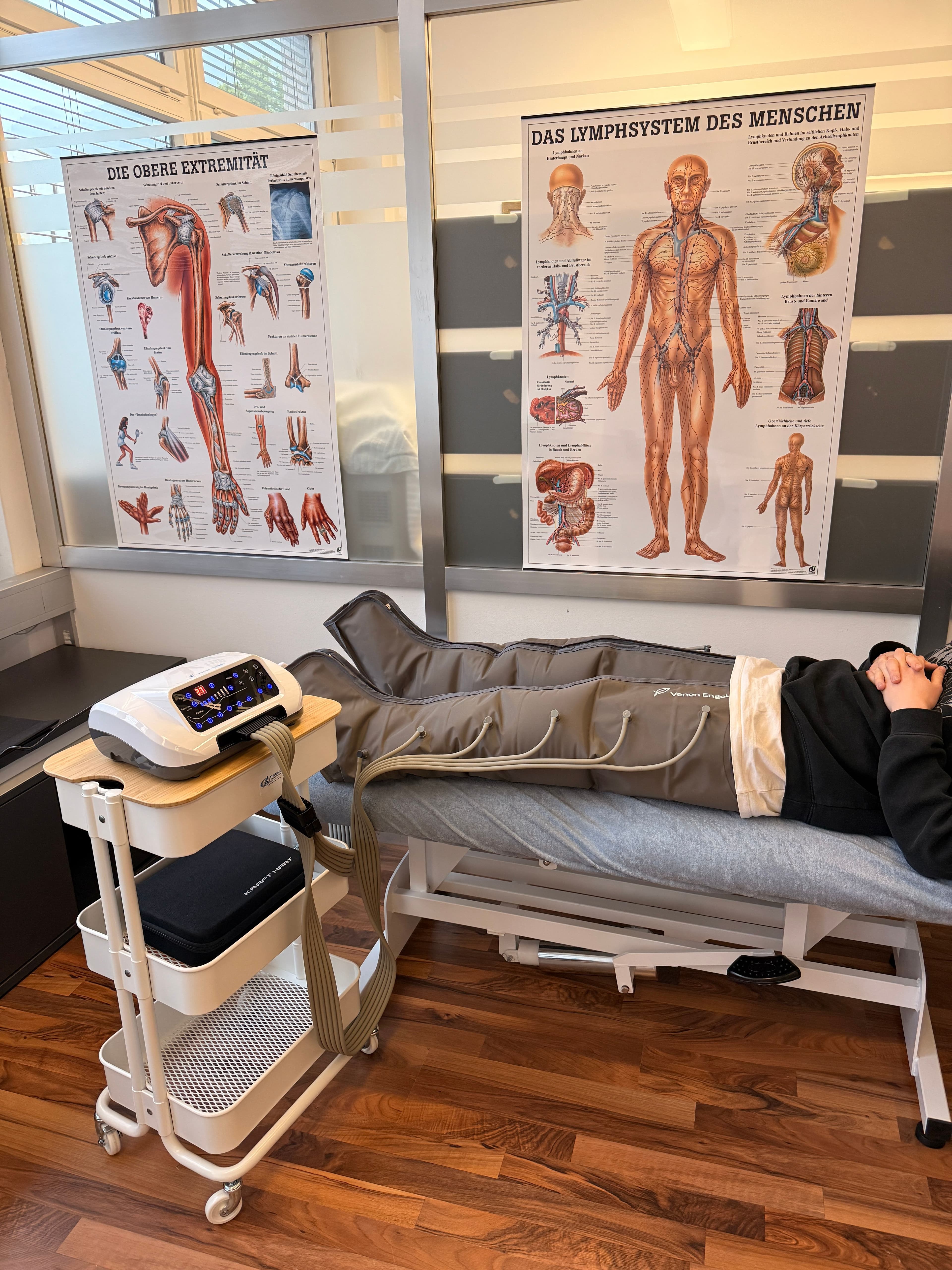
How Can the Treatment Support Swelling and Lymphoedema?
Swelling in the legs or arms can significantly affect mobility, tissue tension, and everyday life.
Particularly in people with lymphoedema or certain venous problems, fluid may accumulate in the tissues.
Many patients therefore ask:
How can intermittent pneumatic compression be used for swelling and lymphoedema?
Intermittent pneumatic compression, also known asIPC, is a device-based treatment method.
Special air chamber sleeves are placed around the affected body area. Controlled and rhythmic pressure cycles create alternating phases of compression and release.
When appropriate, the treatment may be used to support the management of tissue swelling.
At Theraist Physiotherapy Bludenz, we do not consider intermittent pneumatic compression an isolated treatment.
Depending on the individual assessment findings, IPC may be integrated into a physiotherapy treatment plan.
What Is Intermittent Pneumatic Compression?
Intermittent pneumatic compression is a device-based treatment method that uses special sleeves containing multiple air chambers.
These sleeves may be applied to the legs or arms.
During treatment, the individual air chambers are filled with air in a controlled manner and then released.
This creates alternating pressure cycles.
The pressure is adjusted according to the treatment goal and the individual's situation.
IPC may be used as a supportive treatment for certain types of swelling and tissue congestion.
How Does Intermittent Pneumatic Compression Work?
During treatment, the patient sits or lies in a comfortable position.
The appropriate compression sleeve is placed around the body area being treated.
The device then produces controlled pressure cycles.
Depending on the system used, the air chambers are filled sequentially or according to specific pressure patterns.
This creates rhythmic pressure on the treated tissue.
When appropriate, the treatment may provide mechanical pressure to the tissue and support the management of swelling.
The pressure intensity and duration of treatment are individually adjusted.
When Can IPC Be Used?
Intermittent pneumatic compression may be used as a supportive treatment for certain conditions.
Possible areas of application include:
- Lymphoedema
- Certain venous problems
- Swelling of the legs
- Swelling of the arms
- Tissue congestion
- A feeling of tension in the limbs
- Certain postoperative swellings
- Selected chronic oedemas
Whether IPC is suitable for a specific condition depends on the individual's medical and physiotherapy situation.
An individual assessment is therefore important before treatment.
What Is Lymphoedema?
Lymphoedema is a type of swelling that may develop when lymphatic transport is impaired.
The lymphatic system is involved, among other functions, in transporting fluid from the tissues.
If this transport is impaired, fluid may accumulate in the tissue.
Lymphoedema can have different causes.
A distinction is often made between primary and secondary lymphoedema.
Primary lymphoedema may be associated with congenital changes in the lymphatic system.
Secondary lymphoedema may occur, for example, after certain surgical procedures or medical treatments.
The severity and symptoms can vary from person to person.
What Symptoms Can Occur with Lymphoedema?
The symptoms of lymphoedema may vary.
Possible symptoms include:
- Swelling of an arm or leg
- A feeling of tension
- A feeling of heaviness
- Changes in the tissue
- Reduced mobility
- Pressure sensations
- Differences in limb circumference
- Symptoms during prolonged physical activity
New or unexplained swelling should first be medically assessed.
Not every swelling is automatically lymphoedema.
Can IPC Be Used for Lymphoedema?
For certain types of lymphoedema, intermittent pneumatic compression may be used as a complementary treatment.
Treatment should be adapted to the individual's situation.
An important consideration is the underlying cause of the swelling and which therapeutic measures are appropriate.
Depending on the assessment findings, IPC may be combined with other measures.
These may include:
- Movement
- Active muscle activity
- Manual lymphatic drainage
- Compression
- Individual advice
- Adapted physical activity
The choice of treatment depends on the individual assessment findings.
What Is the Difference Between IPC and Manual Lymphatic Drainage?
Intermittent pneumatic compression and manual lymphatic drainage are different treatment methods.
During manual lymphatic drainage, the physiotherapist uses specific manual techniques.
Treatment can be individually adapted to the affected body areas and clinical findings.
With IPC, pressure is generated by a device-based compression system.
Special air chamber sleeves create controlled phases of compression and release.
Depending on the individual's situation, both methods may be used as part of a treatment plan.
However, IPC does not automatically replace an individual medical or physiotherapy assessment.
Is Intermittent Pneumatic Compression Painful?
Many patients experience the treatment as a feeling of pressure or compression.
During treatment, the sleeves fill with air and apply controlled pressure to the treated body area.
The pressure intensity should be individually adjusted.
The treatment should not feel severely painful.
If unusual pain, numbness, or other concerning symptoms occur during treatment, the application should be stopped and the situation assessed.
How Long Does an IPC Treatment Take?
The duration of treatment can vary.
It depends on the treatment goal, the affected body area, and the individual's response to the application.
There is therefore no single treatment duration that applies to every patient.
Before and throughout treatment, the development of symptoms and swelling should be regularly assessed.
How Often Should IPC Be Performed?
The frequency of intermittent pneumatic compression is also individual.
It may depend on several factors.
These include:
- Cause of the swelling
- Severity of the symptoms
- Affected body area
- Physical capacity
- Response to treatment
- Other therapeutic measures
The number of treatment sessions alone is not the most important factor.
An important question is:
How are swelling, tissue tension, and physical function developing throughout the treatment process?
Treatment should therefore be regularly reviewed and individually adapted.
Can IPC Be Used After Surgery?
Swelling may occur after certain surgical procedures.
Whether intermittent pneumatic compression can be used depends on the type of surgery, the stage of recovery, and any medical instructions.
Not every postoperative swelling should automatically be treated with IPC.
Before treatment, it should therefore be individually assessed whether the application is appropriate.
Medical instructions and possible physical load restrictions must be considered.
When Should IPC Not Be Used?
Intermittent pneumatic compression is not suitable for every patient.
For certain medical conditions or acute symptoms, treatment may not be appropriate or may only be used following medical consultation.
Particular caution may be required in certain acute vascular conditions, acute inflammation, or severe cardiovascular diseases.
New, one-sided, or unexplained swelling should also be medically assessed before treatment.
An individual assessment is therefore carried out before IPC is used.
What Role Does Movement Play in Swelling?
Movement can play an important role in certain types of swelling.
Muscle activity may support the body's transport mechanisms.
Depending on the individual's situation, active exercises may therefore be included in physiotherapy treatment.
Possible training areas include:
- Active leg or arm movements
- Gait training
- Mobility exercises
- Individually adapted strength training
- Functional everyday movements
Suitable exercises depend on the cause of the symptoms and the individual's physical condition.
Is IPC Alone Enough?
Intermittent pneumatic compression should not automatically be considered a standalone treatment.
At Theraist Physiotherapy Bludenz, IPC may be used, when appropriate, as part of an individual treatment plan.
Depending on the assessment findings, treatment may also include:
- Manual lymphatic drainage
- Active exercise therapy
- Individual movement training
- Mobilisation
- Functional training
- Individual advice
- A personalised exercise programme
Our goal is not only to focus on visible swelling.
We consider the individual's situation, physical function, and possible factors contributing to the symptoms.
Intermittent Pneumatic Compression in Bludenz
Are you experiencing swelling, tissue tension, or diagnosed lymphoedema?
At Theraist Physiotherapy Bludenz, intermittent pneumatic compression may be used, when appropriate, as part of an individual physiotherapy treatment plan.
Depending on the assessment findings, treatment may include:
- Intermittent pneumatic compression
- Individual physiotherapy assessment
- Manual lymphatic drainage
- Active exercise therapy
- Individual movement training
- Functional exercises
- Individual advice
We treat patients from Bludenz and the surrounding region, including Bürs, Nüziders, Ludesch, Thüringen, the Brandnertal, Montafon, and the Walgau.
Our goal is to individually assess your symptoms and develop a suitable physiotherapy treatment approach together with you.
Please Note: This content is provided for general informational purposes only and does not replace an individual medical or physiotherapy assessment. If you experience new, severe, or unexplained symptoms, a medical evaluation may be necessary.
Important: If you experience sudden weakness or paralysis, numbness or loss of sensation, or problems with bladder or bowel control, seek immediate medical attention.
Begin your journey
Fill in the form – we will contact you within 24 hours for a no-obligation first appointment.
Book appointment
